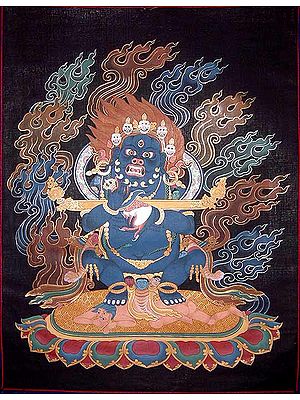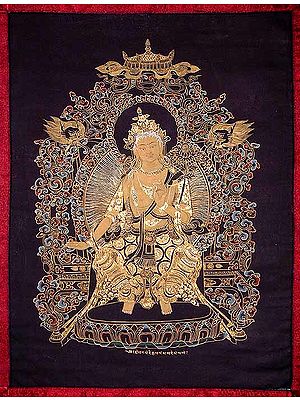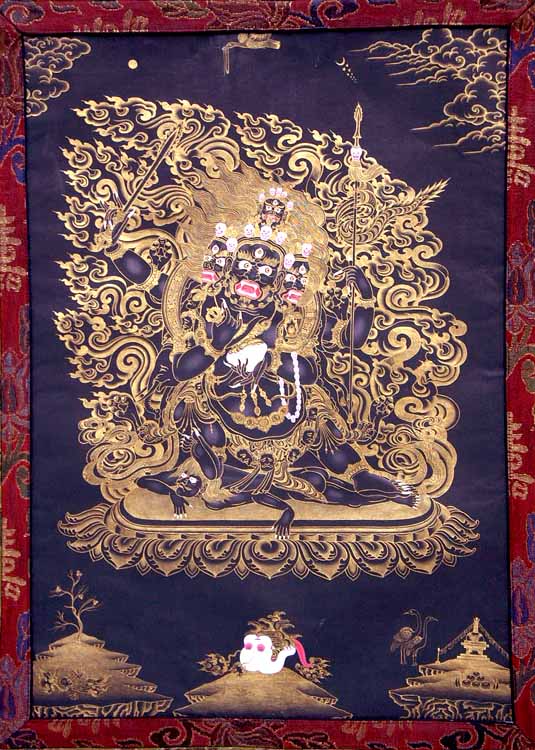
The painting is a beautiful Tibetan black thangka with fine gold lines. Such
paintings are utilized especially for depicting
wrathful deities and exude
great mystery. The images themselves, though very expressive and powerful,
are extremely delicate and well drawn.
Mahakala is the wrathful manifestation of Avalokiteshvara, the bodhisattva
of compassion. He is one of the main deities of Tibetan Buddhism, and is
considered both a meditational deity, or yidam, and a protector deity.
Following his practise would result in reaching two goals: the excellent
goal, meaning that the practitioner becomes a Buddha; and the common goal,
meaning that Mahakala would remove obstacles, grant knowledge and fulfil
wishes.
He is shown here with four wrathful heads, each of which has a third eye.
His fierce open mouths bare his awesome fangs. Each of his head is
surmounted by a five-skull crown. His crown of five skulls represents the
five main afflictions of anger, greed, pride, envy, and ignorance and their
corresponding transformation into positive virtues. His hair stands upright
behind the crown, flame-shaped. He is surrounded by a flame like golden
aureole. This billowing mass of flames that surrounds wrathful deities is
described as a 'blaze of awareness fire'. The energy of the wisdom of these
wrathful forms blazes like the sun's inexhaustible fire. The sun, as a
symbol of pure wisdom, is consumed with fire, yet is not itself consumed.
Its eternal fire is inexhaustible. The wrath of these deities is not
ordinary anger, but wisdom-anger manifesting in its most indestructible or
vajra nature, carrying the capacity of terrifying all evil spirits.
The twisting and blazing fiery aureole surrounding Mahakala is also
described as kalagni, meaning the 'fire of time'. Literally it is the 'fire
at the end of time', according to Buddhist ideals, the ultimate
conflagration of the universe at the end of this aeon.
The aureole flames are drawn with much grace and expression of movement, the
flames curl to one side and leap out at the other. This transverse movement
of the flames enhances the dynamic body posture of Mahakala, full of
vitality and movement.
His eyebrows too are like small flames, and his beard is made of golden hook
like shapes.
He wears many ornaments on his body, and a necklace of fifty freshly severed
human heads. A tiger skin is around his loins and he tramples upon a human
figure, denoting obstacles.
Each of our thangkas comes framed in silk brocade and veil, ready to be hung in your altar.
Free Shipping. Delivered by
to all international destinations within 3 to 5 days, fully insured.
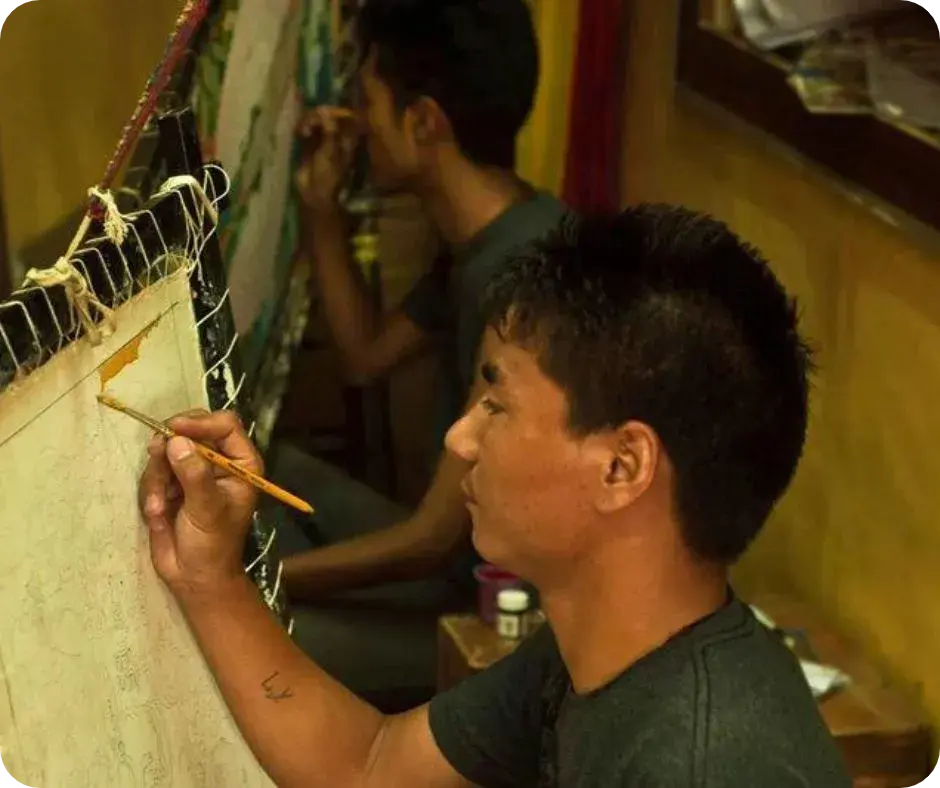
Unveiling the Divine Art: Journey into the Making of Thangkas
A Thangka is a traditional Tibetan Buddhist painting that usually depicts a Buddhist Deity (Buddha or Bodhisattva), a scene, or a mandala. These paintings are considered important paraphernalia in Buddhist rituals. They are used to teach the life of the Buddha, various lamas, and Bodhisattvas to the monastic students, and are also useful in visualizing the deity while meditating. One of the most important subjects of thangkas is the Bhavacakra (the wheel of life) which depicts the Art of Enlightenment. It is believed that Thangka paintings were developed over the centuries from the murals, of which only a few can be seen in the Ajanta caves in India and the Mogao caves in Gansu Province, Tibet.
Thangkas are painted on cotton or silk applique and are usually small in size. The artist of these paintings is highly trained and has a proper understanding of Buddhist philosophy, knowledge, and background to create a realistic and bona fide painting.
The process of making a thangka begins with stitching a loosely woven cotton fabric onto a wooden frame. Traditionally, the canvas was prepared by coating it with gesso, chalk, and base pigment.

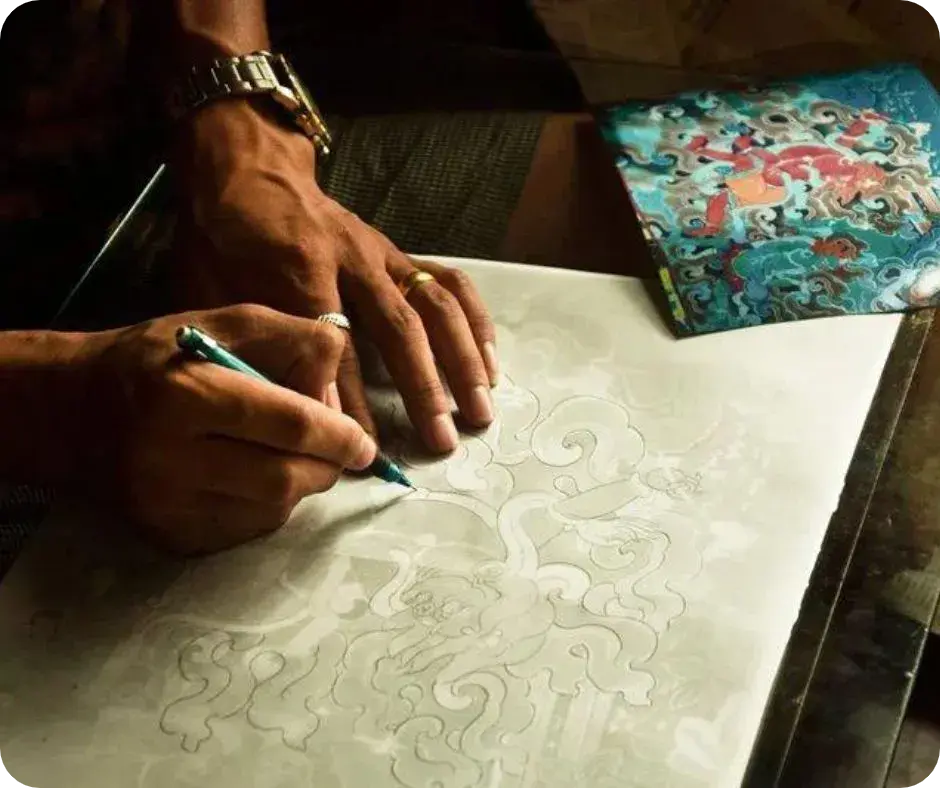
After this, the outline of the form of the deity is sketched with a pencil or charcoal onto the canvas using iconographic grids. The drawing process is followed in accordance with strict guidelines laid out in Buddhist scriptures. The systematic grid helps the artist to make a geometrical and professional painting. When the drawing of the figures is finalized and adjusted, it is then outlined with black ink.

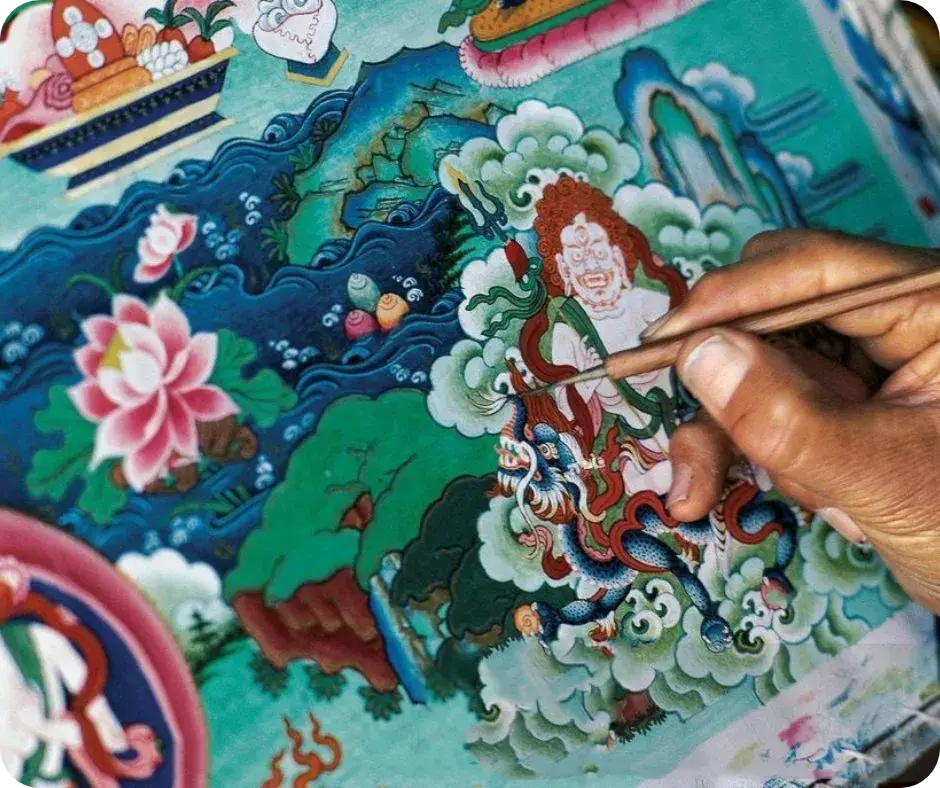
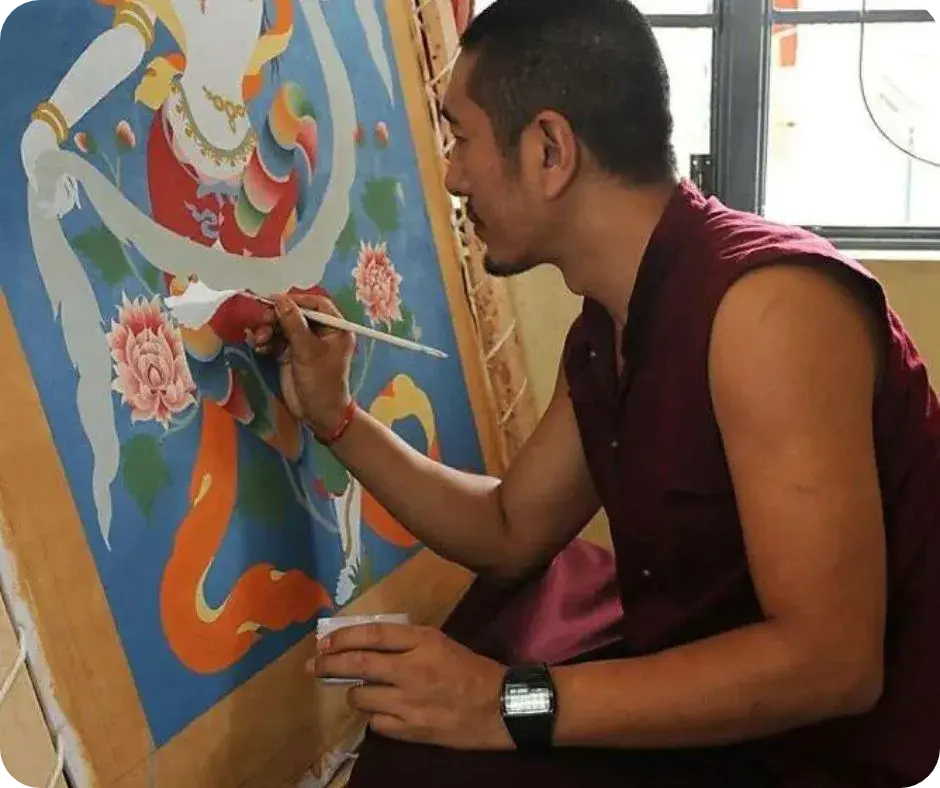
Earlier, a special paint of different colors was made by mixing powdered forms of organic (vegetable) and mineral pigments in a water-soluble adhesive. Nowadays, artists use acrylic paints instead. The colors are now applied to the sketch using the wet and dry brush techniques. One of the characteristic features of a thangka is the use of vibrant colors such as red, blue, black, green, yellow, etc.

In the final step, pure gold is coated over some parts of the thangka to increase its beauty. Due to this beautification, thangkas are much more expensive and also stand out from other ordinary paintings.

Thangka paintings are generally kept unrolled when not on display on the wall. They also come with a frame, a silken cover in front, and a textile backing to protect the painting from getting damaged. Because Thangkas are delicate in nature, they are recommended to be kept in places with no excess moisture and where there is not much exposure to sunlight. This makes them last a long time without their colors fading away. Painting a thangka is an elaborate and complex process and requires excellent skills. A skilled artist can take up to 6 months to complete a detailed thangka painting. In earlier times, thangka painters were lamas that spent many years on Buddhist studies before they painted.