

| Specifications |
 |
Publisher: Manohar Publishers And Distributors |
| Author Shaphalya Amatya | |
| Language: English | |
| Pages: 500 | |
| Cover: Hardcover | |
 |
8.6" X 5.8" |
| Edition: 1977 | |
 |
IDE287 |
| Delivery and Return Policies |
 |
|
 |
Returns and Exchanges accepted within 7 days |
 |
Free Delivery |


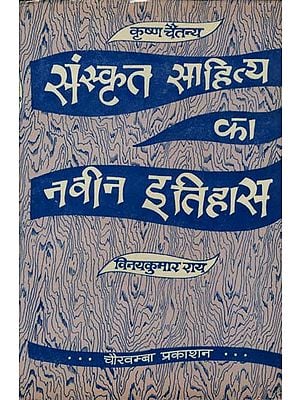
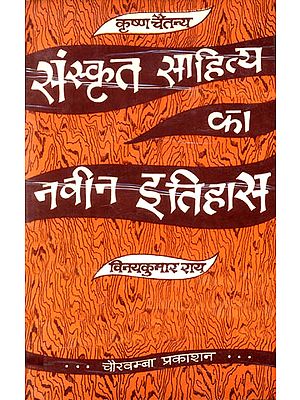
This work on Sanskrit literature has been entitled a "New History", not only because the most recent of the earlier books dates as far back as thirty years ago, but primarily because it is the result of a new vision and approach.
The existing works either confine themselves to the classical period or, when they seem to cover the whole span, highlight the Vedic period. In this work, the author has steadily kept an overall balance as his ideal. It is probably the first time that the Epic histories - Ramayana and Mahabharata receive an extended and genuinely literary evaluation in any history of Sanskrit literature.
Throughout, endeavour has been made to see literary evolution as unfolding within the rich, inclusive matrix of a many-faceted life of the spirit. The introductory chapter outlines this organic background where the analytical exploration of the intellect and the creative capacity of the imagination are correctly seen as the obverse and reverse of the medallion that is the genius of the race. And in the further exposition, the subtle interconnection of literature and political, moral and philosophical thought have been steadily kept in mind.
The author believes that, in the Indian tradition the final resolution of the problems of political order, moral living and philosophical understanding was managed by the aesthetic sensibility. His accounts of political, moral and philosophical thoughts, thus, are not merely useful material but intimately relevant to the real understanding of the integrated vision of the many planes of human action, which we see in Valmiki, Vyasa, Kalidass, Bhavabhuti and others.
With about 1200 references, the work meets the most exacting demands of scholarship, while the ideal ever kept in mind has been to secure for this evaluation of literature some measure of literary worth on its own.
About the Author:
Krishna Chaitanya (b. 1918) graduated from the Madras University standing first both in B.A. and M.A. with Biology as his speciality in the former and English Literature in the latter. He has retained this interest in both sciences and humanities in his subsequent career. He is the author of a serial history of science in Malayalam of which two volumes have already appeared; a well-known music critic; member of the Publication Committee of Sangeet Natak Akademi; a well-known art critic; author of several books on Indian painting; member of the International Association of Art Critics, Paris and of the Advisory Committee of the College of Art, New Delhi: Vice-President of the All India Fine Arts and Crafts Society; Editor of Roopa Lekha, India's oldest extant art journal; author of several children's books which retell Sanskrit classics; member of the Akhil Bharatiya Sanskrit Sahitya Sammelan; and author of a serial history of world literature of which nine volumes have already appeared in English and five Indian languages. He is at present working on a pentalogy on the philosophy of freedom, of which three volumes have been published. His interdisciplinary studies earned for him an invitation from the Institute of International Education, New York, for a lecture tour of the U.S.A. for six months as a 'Critic of Ideas', and a special award from the Kerala Sahitya Akademi. He has also extensively toured Afghanistan, Thailand, China and Japan and visited several European countries.
| PREFACE | vii | |
| 1 | CULTURAL BACKGROUND Contours of History 1; Science and the analytical mind 12; Arts and the creative sensibility 18; Sanskrit language and tradition 25. | 1 |
| 2 | LIFE MIRRORED IN VEDIC LITERATURE Contours of the material 32; Life-view 36; Familial bonds 44; Social bonds 47. | 32 |
| 3 | FORM POETIC MYTH TO POETIC INTUITION The poetic myth 52; Myth as symbol 58; Intuition of God 61; Intuition of eternal law 69. | 52 |
| 4 | THE INWARD QUEST Unity of being 73; Psychological analysis 82; Return to the world 87; Germinal wealth 93. | 73 |
| 5 | ENGAGEMENT WITH SOCIAL REALITY Ethical law and social control 100; Sublimation of law as love 108; The Political order 117. | 100 |
| 6 | ADVENTURE INTO THE TRANSCENDENT The negative systems 134; Pluralist systems 140; Monist identity 148; Patterns of polarized dualism 153; The Synthesis of the Gita 160. | 134 |
| 7 | EPIC HISTORIES The Ramayana 170; The Mahabharata 200. | 170 |
| 8 | EPIC LEGENDS Hindu Puranas 220; Buddhist legends 228; Jain legends 235. | 220 |
| 9 | EPIC POEMS Origins 240; Asvaghosha 243; Kalidasa 250; Later epics 265; Historical epics 276. | 240 |
| 10 | DRAMA Origins 284; Bhasa and Sudraka 289; Kalidasa 311. | 284 |
| 11 | LATER DRAMA Visakhadatta 323; Harsha 328; Bhavabhuti 332; Decadent profusion 342; Social comedy 352. | 323 |
| 12 | XII STORY NOVEL CHAMPU The best-fable 360; The Popular tale 366; Dandin 375; Subandhu 381; Bana Bhatta 384; The Champu 397. | 360 |
| 13 | POETRY Devotional hymns 402; Love lyrics 414; Nature and life 427; Comment on life 434. | 402 |
| REFERENCES | 447 | |
| INDEX | 481 |





Send as free online greeting card




Visual Search
 Upload an Image
