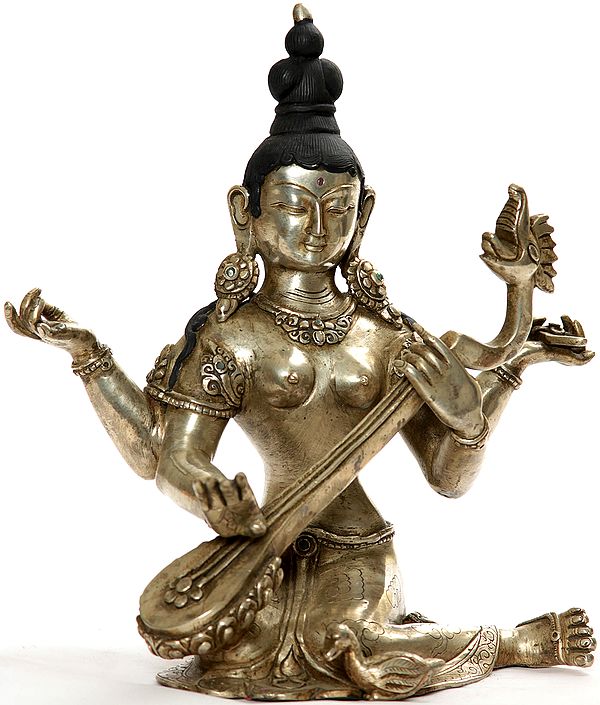
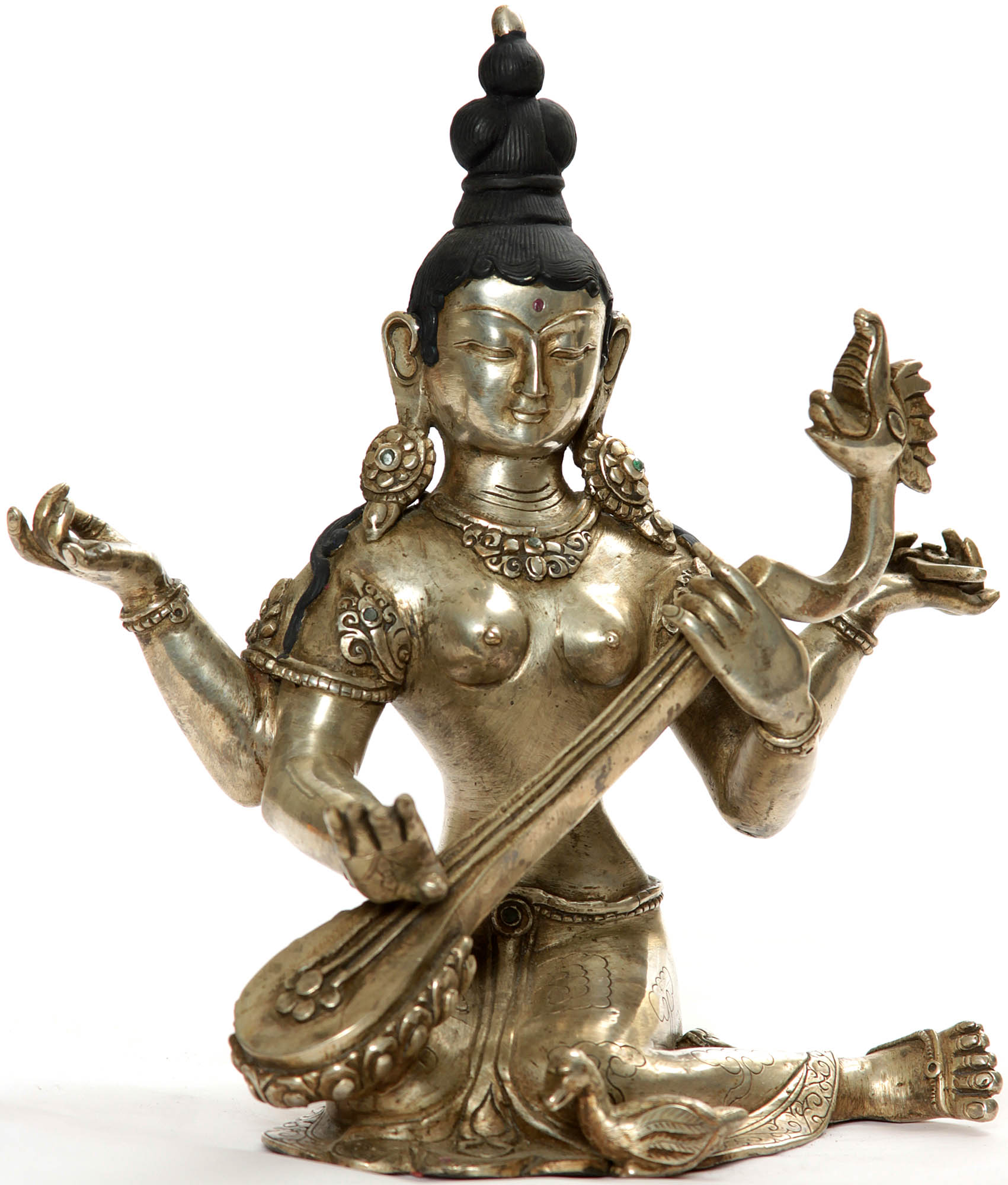
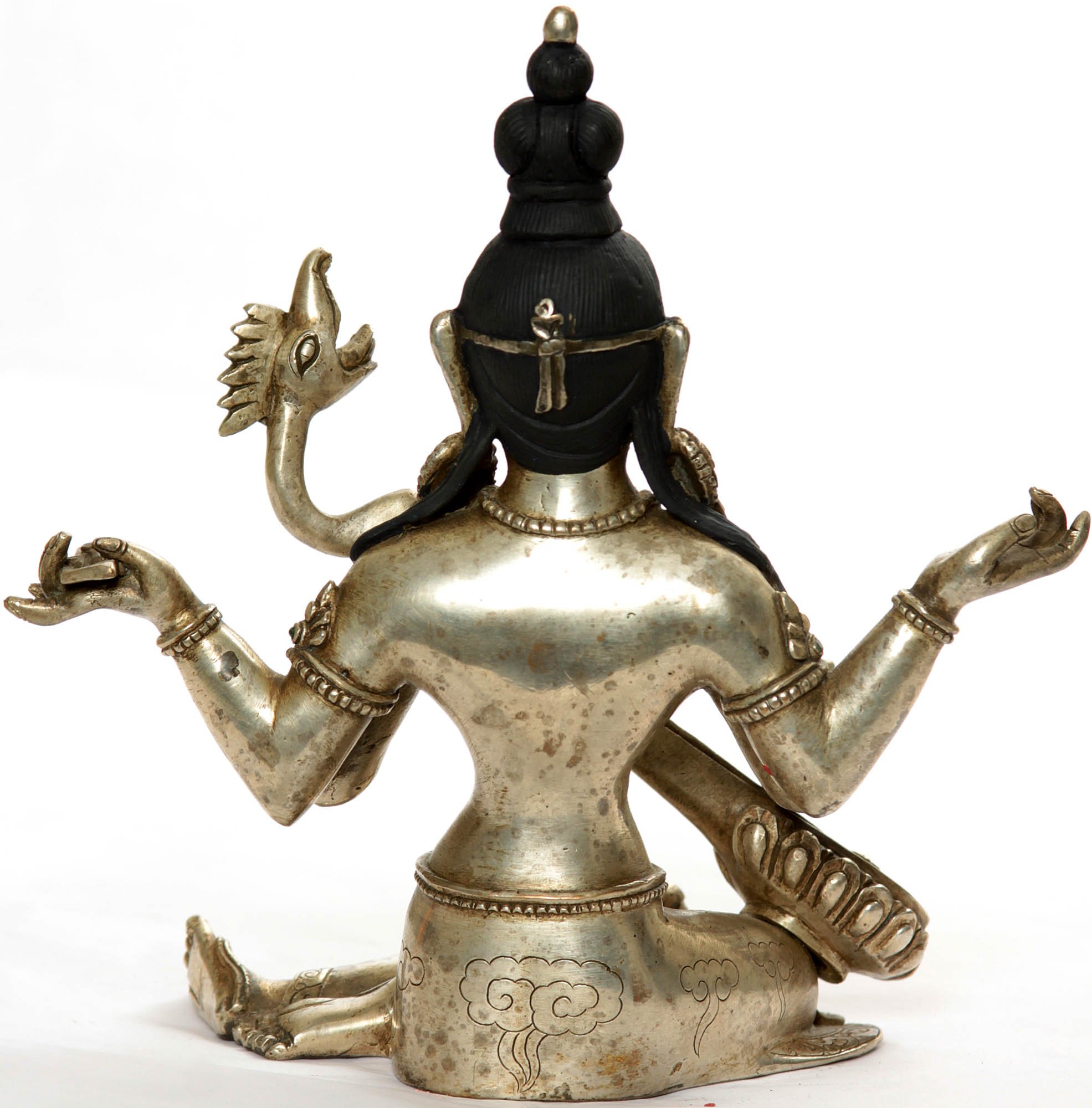
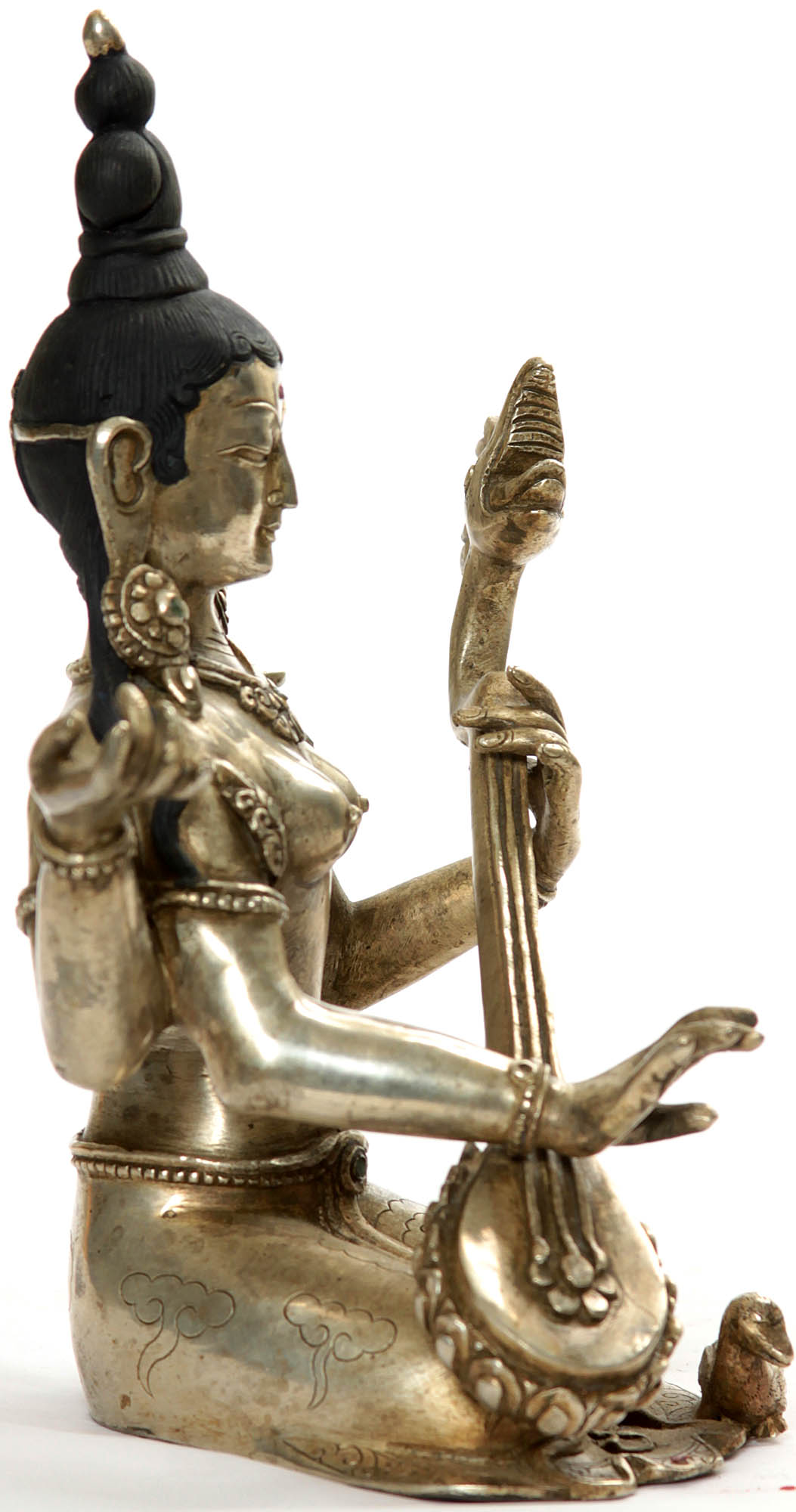
This perfectly modeled silver plated tiny copper cast represents
goddess Saraswati, the embodiment of learning, music, art, literature
and all creative faculties of mind. A Nepalese version of the goddess
presenting a rare, as well as most delightful, synthesis of the
iconographies and divine attributes of the Buddhist
White Tara and
Saraswati of the Hindu texts, this form represents her as playing on
‘vina’, a stringed instrument, which symbolizes her all creative
aspects. Besides that the Buddhism perceives White Tara as Bodhichitta
– the all-knowing mind of the Bodhisattva, an equivalent of learning –
Saraswati’s essential attribute, she also embodies compassion,
longevity and freedom from every kind of illness. She is also revered
as the wish-fulfilling tree. Obviously, this form of Saraswati,
besides embodying what she does in her own form, represents also the
high virtues like compassion, long life and freedom from illnesses.
As regards the physiognomy of the figure, a four-armed form holding in
two of them the ‘vina’, carrying in the third, a text, and the fourth
held in the ‘mudra’ – posture, of commemoration, as if turning beads
of a rosary : ‘vina’, ‘pustaka’ and ‘japamala’ all are the essential
attributes of Saraswati. However, besides the dragon-head of her
‘vina’, design-patterns on her ‘antariya’ – lower wear, character of
her ornaments, especially her ear-pendants, armlets and the
amulet-type necklace, or her casual sitting posture, the style of her
coiffure reveals strong influence of the Buddhist iconography of White
Tara. In the iconography of White Tara the coiffure usually carries a
tiny icon of the Buddha. Sometimes it is alternated by ‘Tri-ratna’
motif. In both cases the coiffure’s apex consists of ‘Mani’, a term
suggestive of the totality of Buddhist dogma which no other term in
any language has ever succeeded in imparting in its exact meaning.
Obviously, the three knots of the hair, and the fourth, a circular
shining apex, in this Saraswati statue represent ‘Tri-ratna’ and
‘Mani’ and are essentially the elements of Tara’s iconography.
Unlike the standard or conventional form of the image of the goddess
painted or sculpted as seated on a lotus, goose, peacock … the goddess
has been represented as squatting on the floor with her legs turned to
back. She has her mount goose, a tiny figure of the bird perching
close-by but conceived as carefree roaming around or listening to her
‘vina’ the bird is suggestive of her compassion and love rather than
that of its relationship to her as her mount. A most accomplished
anatomy with faultless modeling revealing a rare plasticity and divine
aura the statute is superb in its beauty and divinity. A sharp nose,
large meditative eyes, cute small lips not larger than the chin’s
breadth, and the angular chin, on a squarish face define
Tibetan/Nepalese iconographic character. Both Saraswati and White Tara
have been meditated on as white, moon-like radiant and endowed with
divine lustre, which this statue adequately justifies.
This description by Prof. P.C. Jain and Dr. Daljeet. Prof. Jain specializes on the aesthetics of literature and is the author of numerous books on Indian art and culture. Dr. Daljeet is the curator of the Miniature Painting Gallery, National Museum, New Delhi. They have both collaborated together on a number of books.
How are Nepalese copper statues made?
Nepalese statues and sculptures are best known for their unique
small religious figures and ritual paraphernalia for over two
thousand years. These are mainly cast in copper alloy. Nepal draws
influences from the artistic styles of Buddhism and Hinduism, and
therefore the sculptors of the country specialize in making the
icons of both these religions. Over the years, Nepalese sculptures
evolved into their own distinctive iconography. Some
characteristic features of these sculptures that differ from other
pieces are exaggerated physical postures, youthful and sensual
features, languid eyes, wider faces having serene expressions, and
ornate flourishes. The Buddhist deity icons of Nepal have
tremendous demand in countries such as China and Tibet for ritual
purposes in their temples and monasteries.
Nepalese statues and sculptures have a high copper content and
therefore develop a slightly reddish patina on the surface as they
age. However, the most unique feature of Nepalese copper statues
is their decorative detailing. The pieces are heavily gilded and
sometimes inlaid with semi-precious stones. This embellishment
protects them from getting tarnished. The traditional lost-wax
method for casting Nepalese copper statues remains the most
practiced technique in Nepal for many centuries. This process
involves many steps and requires skilled artists.
The first step in lost-wax sculpting is to make a wax replica of
the desired Buddhist deity to be cast in copper. This replica is
created by hand and therefore needs excellent artistic skills
otherwise fine features will be lacking.
Once the wax replica is made, it is then coated with a special
mixture of clay with a brush. This layer of clay is hardened when
left to dry. A small hole is made on the base of the wax mould so
that the wax flows away when it is heated.
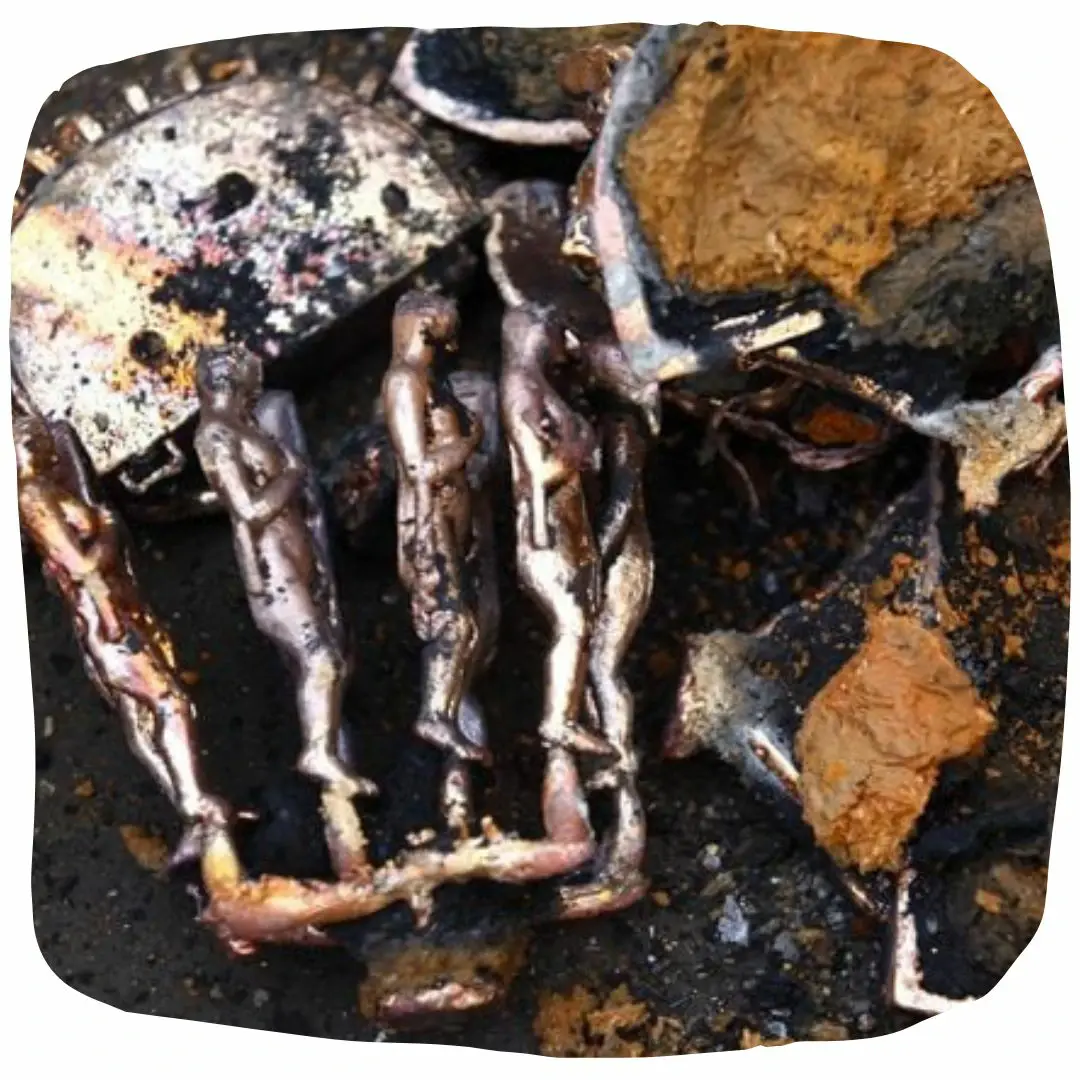
At this stage, a hollow mould in the shape of the deity is
obtained.
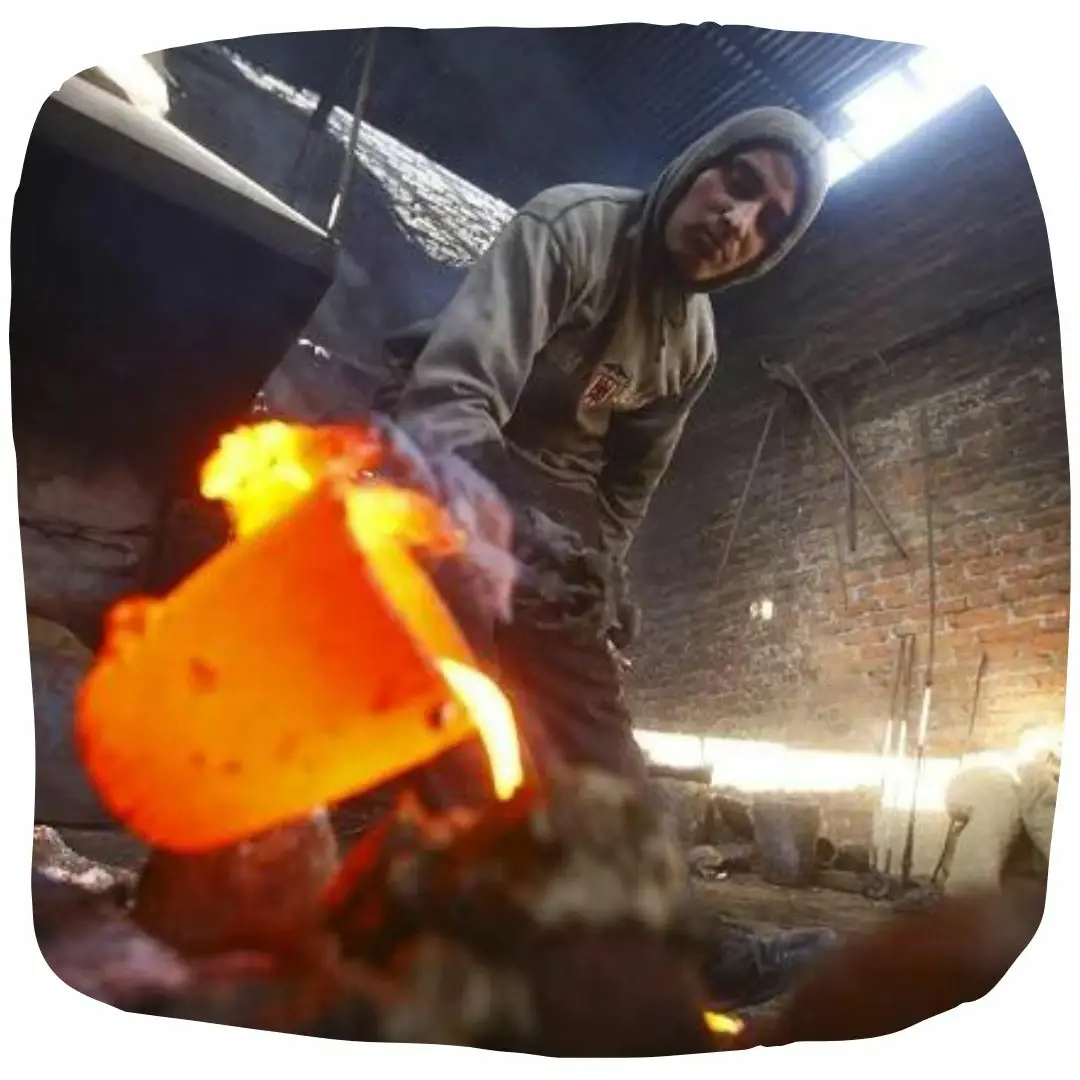
This is the time to pour liquid copper into the hollow mould which
is then allowed to cool and harden inside a container of cold
water. When the liquid metal has hardened, the mould is removed
and the statue within is revealed.
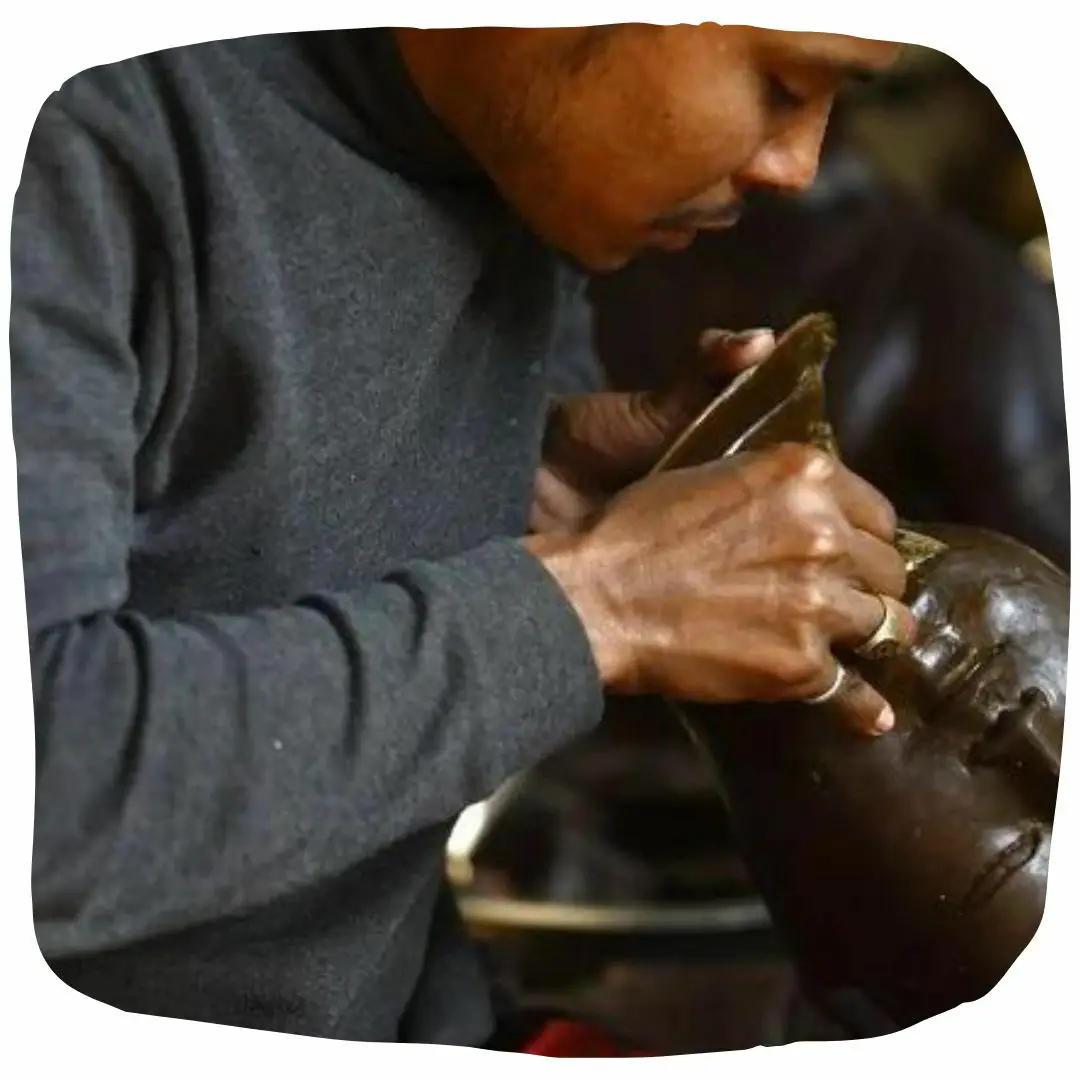
The artist works on the details of the statue using various tools.
It is then polished to get a shiny and lustrous surface.
Now comes the most important part of Nepalese art which is gold
gilding. This is done by the traditional fire gilding method. A
mixture of mercury and 18K gold is applied on the surface of the
statue and heat is applied using a flame torch. The result is that
mercury evaporates along with impurities, leaving a pure 24K gold
finish.
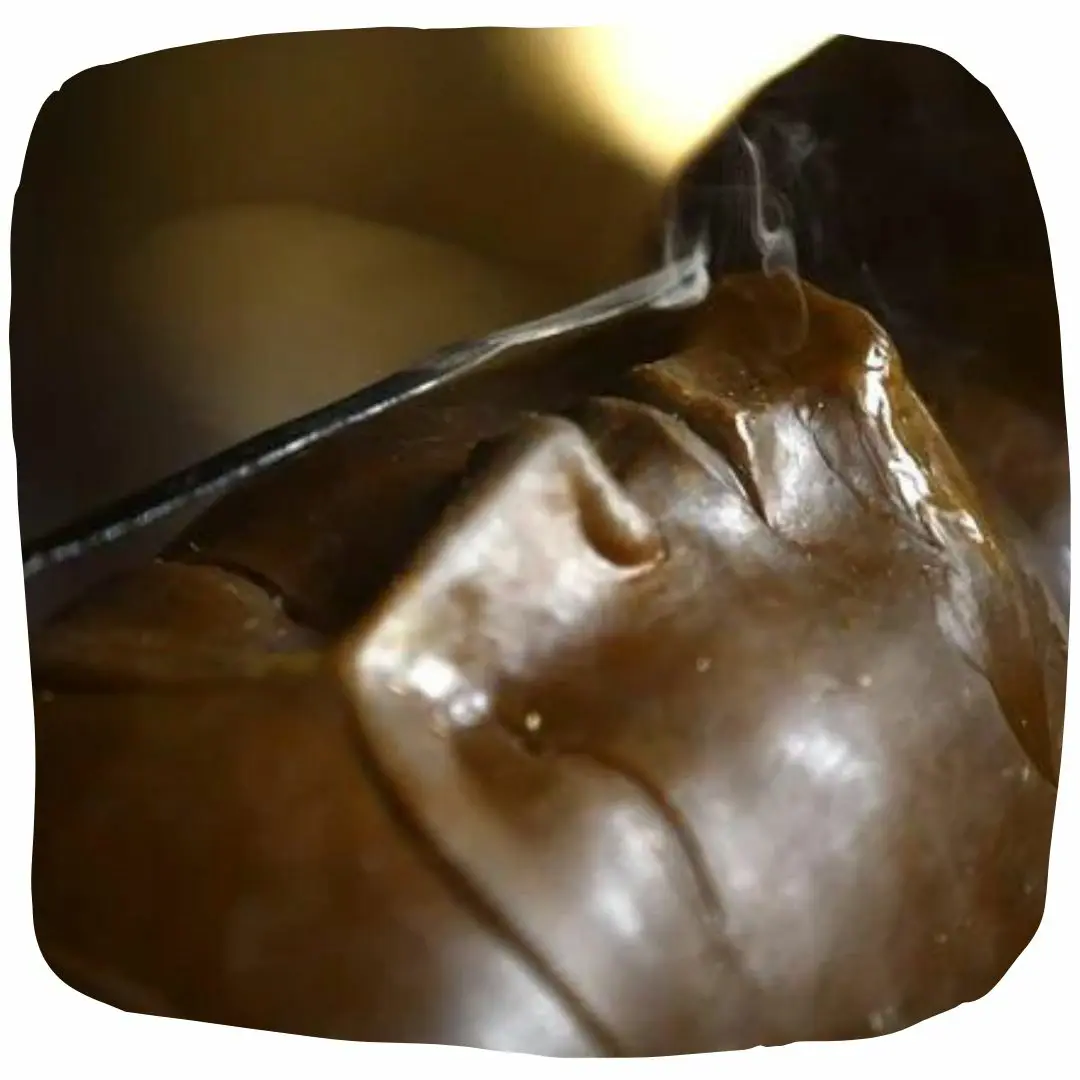
The lost-wax method of sculpting is the most preferred technique
for artists to cast a metallic statue having intricate details.
Since Nepalese copper sculptures require extraneous effort for
giving a majestic look by adding special embellishments, it takes
several weeks to complete one masterpiece. A 24K gold gilded
copper sculpture retains its brilliant luster for many years and
appears as like before. Nepalese sculptures continue to remain one of the finest specimens of the art of the East that have a strong
aesthetic appeal that other sculptures cannot match.