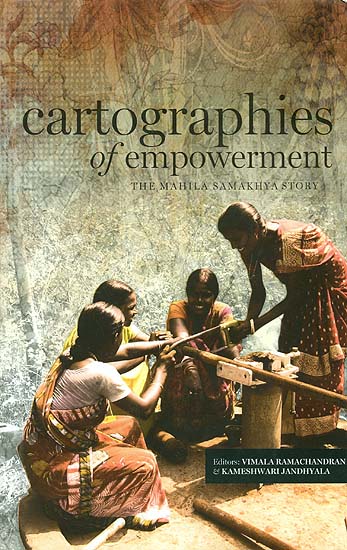
Cartographies of Empowerment (The Mahila Samakhya story)
| Specifications |
 |
Publisher: Zubaan Publications |
| Author: Vimala Ramachandran Kameshwari Jandhyala | |
| Language: English | |
| Pages: 522 | |
| Cover: Hardcover | |
 |
8.5 inch X 5.5 inch |
 |
Weight 560 gm |
| Edition: 2012 | |
| ISBN: 9789381017210 | |
 |
NAG208 |
| Delivery and Return Policies |
 |
Returns and Exchanges accepted within 7 days |
 |
Free Delivery |


About the Book
Mahila Samakhya is as much
a story of a government programme for women's
education and empowerment, as it is of the celebration of the struggles of poor
women for their rights. Spread across eight states and more than 150 districts
in India, the Mahila Samakhya
programme grew out of a unique partnership between
the women's movement and the government. In this collection of essays,
concerned scholars from different parts of India chart Mahila
Samakhya's fascinating journey of setting up poor
women's collectives and women's agency in establishing an equal space and voice
in the public domain a radical departure from the more common approaches of
organizing women around economic concerns.
The
writers explore broad gender issues grounded within the field experience of Mahila Samakhya, providing
insights into the workings of the programme at
different levels, its conceptual challenges, strategic choices, the
opportunities and pitfalls of partnership with government and above all the
willingness of poor women to come together voluntarily to address and overcome
gender barriers.
About the Author
Vimala Ramachandran is
currently National Fellow at the National University for Educational planning
and Administration (NUEPA), New Delhi. She has been working on girls' and
women's education, elementary education and gender issues for several years.
She was the first National project Director of Mahila
Samakhya (1989-93) and the founder Director of ERU
Consultants Pvt. Ltd, New Delhi. She has written extensively on education and
development issues. Her publications include Getting Children Back to School.
Case Studies in Primary Education (2003); Hierarchies of Access: Gender and
Equity in primary Education (2004); Ground Realities: Abortion in India (2007,
with Leela Visaria) and The
Elementary Education System in India: Exploring Institutional Structures and Dyanamics (2008, with Rashmi
Sharma).
Kameshwari Jandhyala, Director
with ERU Consultants Pvt Ltd., has had a long
association with Mahila Samakhya
as Director in Andhra Pradesh, member of the national team and subsequently as
member of the National Resource Group. She is currently engaged in qualitative
research on gender and equity issues in education and is a member of the
Standing Committee on the Women's Studies programme
of the University Grants Commission.
Introduction
Mahila Samakhya (MS) never
fails to become the centre of discussions whenever issues of women's
empowerment, the women's movement and the state, and government and civil
society partnerships come up. For those of us who were associated with the programme in its earlier phases, so much in this
partnership was taken for granted that even today it remains assumed rather
than explicitly stated. The context that threw up this programme
gave several of us our first experiences of working in civil society movements
and organizations in partnership with the government. For younger colleagues
who did not have a similar background the programme,
its roots and its rationale were issues they became familiar with in
orientation workshops and trainings. When, as authors of this essay we began to
discuss how we would write it, younger colleagues in our team asked us to
explain the mid 1980s context that led to the government playing a significant
role in the empowerment of women. This is what we attempt to do here to capture
the long story and biography of a programme and a
movement.
The
decades of the 1970s and 1980s were turbulent and heady times for social
movements in India and the Mahila Samakhya
(MS) story has to be seen against this context. The churning that was so
evident at the time was not, interestingly, limited to civil society but could
also be seen inside government programmes and in
government thinking. The declaration of s State of Emergency in 1975 shook
people's faith in the abiding strength of the Indian democracy. Two years
later, when Indira Gandhi's Congress party was voted
out of power, some of this faith was restored. Change, people felt, was
possible. The 1977 elections brought in a new coalition government as an anti
Congress wave swept the country. But the euphoria was short lived, by 1979, the
cobbled together coalition had fallen apart, and Indira
Gandhi and the Congress party were voted back to power with a renewed majority.
The scars and wounds of the Emergency, however, continued to fester, leading to
widespread unrest in the country. As well, politics saw the rise of regional
ide3ntities, and in many areas the assertion of caste and community identities
led to a period of discontent and protests. This was also the time when many
peoples' movements sprung up across the country against alcoholism, against the
felling of trees (the nascent environment movement), against domestic violence
and sexual harassment to name only a few. The widespread unrest on the ground
was further exacerbated by the poli8tical and social fallout of the tragic
events of 1984 when the assassination of Indira
Gandhi led to riots and mass killing in Delhi and some neighboring areas. The
Congress party acquired a new face with the entry of Rajiv Gandhi, began the
process of the opening up of the economy and development discourse, policy and programmes cast in terms of meeting global standards. One
of the interesting consequences of the turbulence and upheaval in Indian
politics was that people began to see and acknowledge that the government was
not a monolith, that it could have many faces and many internal contradictions.
At some level there was also a sense that the government was answerable to the
people who elected it, and that they could have a say in how it works. This
renewed peoples' faith in the belief that the ability to influence the
government was not limited to social activists alone. Within the government,
civil servants with a 'progressive' outlook came to believe that they could
also make a difference. Several worked closely with social activists and
support for many of these activities came from an unexpected quarter the media,
with both print and broadcast media, particularly alternative cinema, playing
an important part. It was a period that inspired and radicalized an entire
generation of women, in their homes, at the workplace, in government offices,
in colleges and universities and in the media.
It
was at this moment, when various aspects of governance, as well as various
policies and programmes were being revisited that the
Ministry of Education brought out a document called Challenge of Education: A
policy perspective (Government of India 1985) that came to be debated across
the country and that resulted, eventually, in the New Education policy of 1986.
The rethinking that led to the framing of the Nep, as
it came to be called, was reflective of the newfound confidence among political
leaders and administrators who brought in bold new programmes
in different areas rural development, women and child development, labour, and of course education. An equally exciting
process was afoot in the country as the women's movement which had influenced
the above process, policies and programmed, continued to gain momentum.
The
Contemporary Women's Movement
Much
of the excitement, rethinking and turbulence of the time was
reflected in the Indian women's movement that gained considerable momentum at
this time. Variously located and therefore somewhat fragmented and complex, the
movement drew in urban and rural women, social activists across class and
caste, nongovernmental organizations (NGOs) and autonomous women's group, party
affiliated women's organizations, government run initiatives, research and
documentation centers, students and university faculty. Across the country,
women led campaigns and vigorously debated issues as diverse as violence,
social discrimination, economic self dependence, environmental protection,
political representation, and globalization. Many debates were contentious and
also took in questions of ideology, organizational structure, and modes of
action.
There
has always been a two way relationship between the women's movement and the
state in India. Formal policies and programmes have
attempted to project the postcolonial Indian state as the primary agent of
development and change (Gupta and Sharma 2006; Ray and Katzenstein 2005), and
as the protector and promoter of the well being of the marginalized, including
women. Some women's organizations, for example social movement organizations
that work with marginalized sections of society, have demanded affirmative
action from the state and have sought protection of the interests of the
marginalized. They have done so with the expectation that the state may and
ought to possess the resources and the opportunities required for bringing
about change that they themselves are not in a position to (Agnihotri
and Palriwala 1993; Purushothaman
1998).
But
the conditions under which these expectations that the state has raised, and
that many women's organizations continue to have from it can be met are no
longer what they once were. The outlook of the Indian state, initially
socialist in a very general sense has changed. Governments, especially since
the second half of the 1980s and more so in the 1990s, increasingly believe
that they have no choice but to liberalize finance and to privatize the
economy. There has also been a growing interface between micro initiatives and
macro policy measures. Governments have tried to promote NGOs to do specific
tasks that they are no longer able to do, and on the whole, probably, no longer
want to do. Further, the political landscape of the country has significantly
changed with the constitutional amendments reviving institutions of local self
government and promoting women's participation, all in the name of
decentralization and enabling people's ownership of local governance and
development processes.
The
state movement relationship and its shifting contours form the backdrop to the Mahila Samakhya programme. The state movement relationship and the changing
political scenario can help us to better understand the specifics of the
historical moment to which the MS programme belongs.
Contents
|
|
Acknowledgements |
vii |
|
|
Cartographies of Empowerment: An Introduction |
1 |
|
1. |
The Making of Mahila Samakhya 1987-199 |
31 |
|
2. |
Scenes from an Expanding Universe: Personal Journeys |
75 |
|
3. |
From Sanghas to Federations: Empowering Processes and Institutions |
105 |
|
4. |
Songs of Change in a minor Key? |
139 |
|
5. |
Between Questions and Clarity: Education in Mahila Samakhya |
171 |
|
6. |
Addressing Girls' Education |
199 |
|
7. |
Mapping the Multiple Worlds of Women's Literacy: Experiences from Mahila Samakhya |
237 |
|
8. |
Responding to Violence and Exploring Justice through Women centered Mechanisms |
270 |
|
9. |
Engendering Mainstream Institutions: The Mahila Samakhya Experience with Panchayats |
307 |
|
10. |
Mahila Samakhya Approaches to women's Health |
360 |
|
11. |
Embedding Economic Empowerment within an Education process: The Mahila Samakhya Experience |
388 |
|
12. |
Revisiting an Ideal called Empowerment: S Reconnaissance of the Mahila Samakhya Experience |
438 |
|
13. |
Ambiguities and Silences |
475 |
|
|
References |
495 |
|
|
Glossary |
508 |
|
|
Notes on Contributors |
510 |
-
Q. What locations do you deliver to ?A. Exotic India delivers orders to all countries having diplomatic relations with India.
-
Q. Do you offer free shipping ?A. Exotic India offers free shipping on all orders of value of $30 USD or more.
-
Q. Can I return the book?A. All returns must be postmarked within seven (7) days of the delivery date. All returned items must be in new and unused condition, with all original tags and labels attached. To know more please view our return policy
-
Q. Do you offer express shipping ?A. Yes, we do have a chargeable express shipping facility available. You can select express shipping while checking out on the website.
-
Q. I accidentally entered wrong delivery address, can I change the address ?A. Delivery addresses can only be changed only incase the order has not been shipped yet. Incase of an address change, you can reach us at help@exoticindia.com
-
Q. How do I track my order ?A. You can track your orders simply entering your order number through here or through your past orders if you are signed in on the website.
-
Q. How can I cancel an order ?A. An order can only be cancelled if it has not been shipped. To cancel an order, kindly reach out to us through help@exoticindia.com.