| Specifications |
 |
Publisher: SUBHASH PRAKASHAN, VARANASI |
| Author O. P. Singh | |
| Language: English | |
| Pages: 170 | |
| Cover: HARDCOVER | |
 |
9.00x5.5 inch |
 |
Weight 300 gm |
| Edition: 1985 | |
 |
HBI718 |
| Delivery and Return Policies |
 |
|
 |
Returns and Exchanges accepted within 7 days |
 |
Free Delivery |


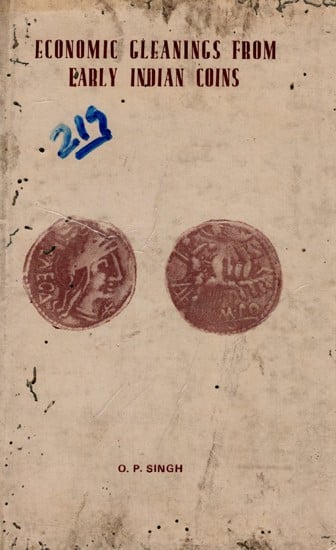
The study of coins in historical reconstruction of India's past is unique. They are, sometimes, unrivalled story tellers. Scholars have dealt with some aspects of the subject. However, none has given a comprehensive and up-to-date picture of the economic history based exclusively on the coins. Therefore, the present monograph is an exhaustive one which discusses the economic gleanings from early Indian coins.
express my deep sense of gratitude to my Guru Professor Dr. U. Thakur, Head, Ancient Indian and Asian Studies, Magadh University, Podh Gaya who has inspired me with his blessings to complete this work, I am highly obliged to Professor Dr U. V. Singh, University of Kurukshetra, Professor Dr. K. K. Thaplyal, University of Lucknow, Professor Dr. A. M. Shastri, University of Nagpur, Professor Dr. V. S. Pathak, University of Goral hpur, Professor Dr. S. N. Chaturvedi, University of Gorakhpur, Professor Dr. L. Gopal Banaras Hindu University and Professor R. C. Gaur, Aligarh Muslim University for their encouragement to complete the work. I am also grateful to Professor Dr. Shivaji Singh, Gorakhpur University, and Dr. Nisar Ahmad, Reader, Banaras Hindu University for giving me their valuable suggestions.
I would like to express my thanks to Sri Jyotish Prakash Yadava, research scholar, Banaras Hindu University, who ex-tended invaluable help. I express my thanks to Sri Bhagawan Prasad Srivastava, the Proprietor of Subhash Prakashan, Varanasi for having taken interest in the publication of the work.
Finally, I crave indulgence of scholars for printing mistakes that have crept in the book.
Coins, an important source of ancient Indian history, have not received proper attention by the scholars to reconstruct the early Indian economic history. The birth of the coin witnessed one of the significant revolutions in the history of mankind because it was harbinger of a new economic world. The study of the evolution of coins, the progress from barter to monetary economy, sometimes, provide interesting information about economic developments. Though the writers on the early Indian economic history 'have tapped the coins as a source, but they have neither indicated the manner of their utilisation nor used them in an appreciable way in their reconstruction of India's economic past. How-ever, the articles of C. R. Chaudhury, R. S. Sharma and U. Thakur are more analytical and elaborate¹. Further, the monograph entitled, "Coins And Early Indian Economy" ed. by A. M. Shastri, enriches our knowledge regarding the role of the coins as a source of economic history of ancient India. R. S. Sharma has aptly remarked that, "the place of coins in the economic life of the people at a particular time and place has still to be determined". Our study has not advanced beyond the specific gravity of coins. But more fruitful data may be culled if we are able to explain the volume of the coins in circulation. The problem of the quantity of coins in early India, though interesting has not received serious attention of the scholars so far. A formula was devised by D.M. Metcalf to assess the quantity of the English coinage of the eight to the eleventh centuries. It was further used in respect of the mediaeval Islamic Coinage in Near Fast. Inspite of the limitations of this formula, we may form a rough quantitative estimate of the coinage in circulation in a particular period and region. More important factor in determining the volume of coinage for economic study is the frequency with which the coins are used.







Send as free online greeting card