About the Book
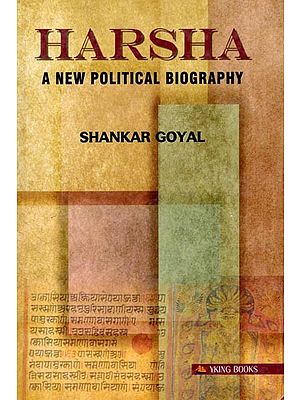
This book illuminates the history of King Harsa, distinguished for its extensive source material, a rarity among early Indian rulers. Chronicled in the Harsa-charita by Bana, his court poet, the narrative provides valuable insights into his life and rule, albeit with occasional poetic flourishes. Yuan Chwang's firsthand observations further enhance our comprehension of Harsa's era, while inscriptions by Harsa and contemporaries like Pulakesin II offer additional perspectives on governance and administration. Stemming from lectures at Calcutta and Lucknow Universities, this comprehensive volume thoroughly examines Harsa's reign, encompassing his military campaigns, administrative strategies, religious practices, economic policies, and social dynamics. Harsa emerges as a pivotal figure in Indian history, leaving an indelible imprint on the subcontinent through his conquests and governance.
About the Author
Radhakumud Mookerji (1884-1963) was an Indian historian and nationalist during the British colonial era. He obtained his doctorate from the University of Calcutta in 1905 and taught at the Bengal National College. Mukherjee served in various academic roles at universities in Benares, Mysore, and Lucknow. Notably, he advocated for the concept of Greater India and authored "Indian Shipping: A History of Seaborne Trade and Maritime Activity of the Indians from the Earliest Times" in 1912. Recognized with the Padma Bhushan in 1957, his notable works include "Men and Thought in Ancient India" and "Nationalism in Hindu Culture."
Preface
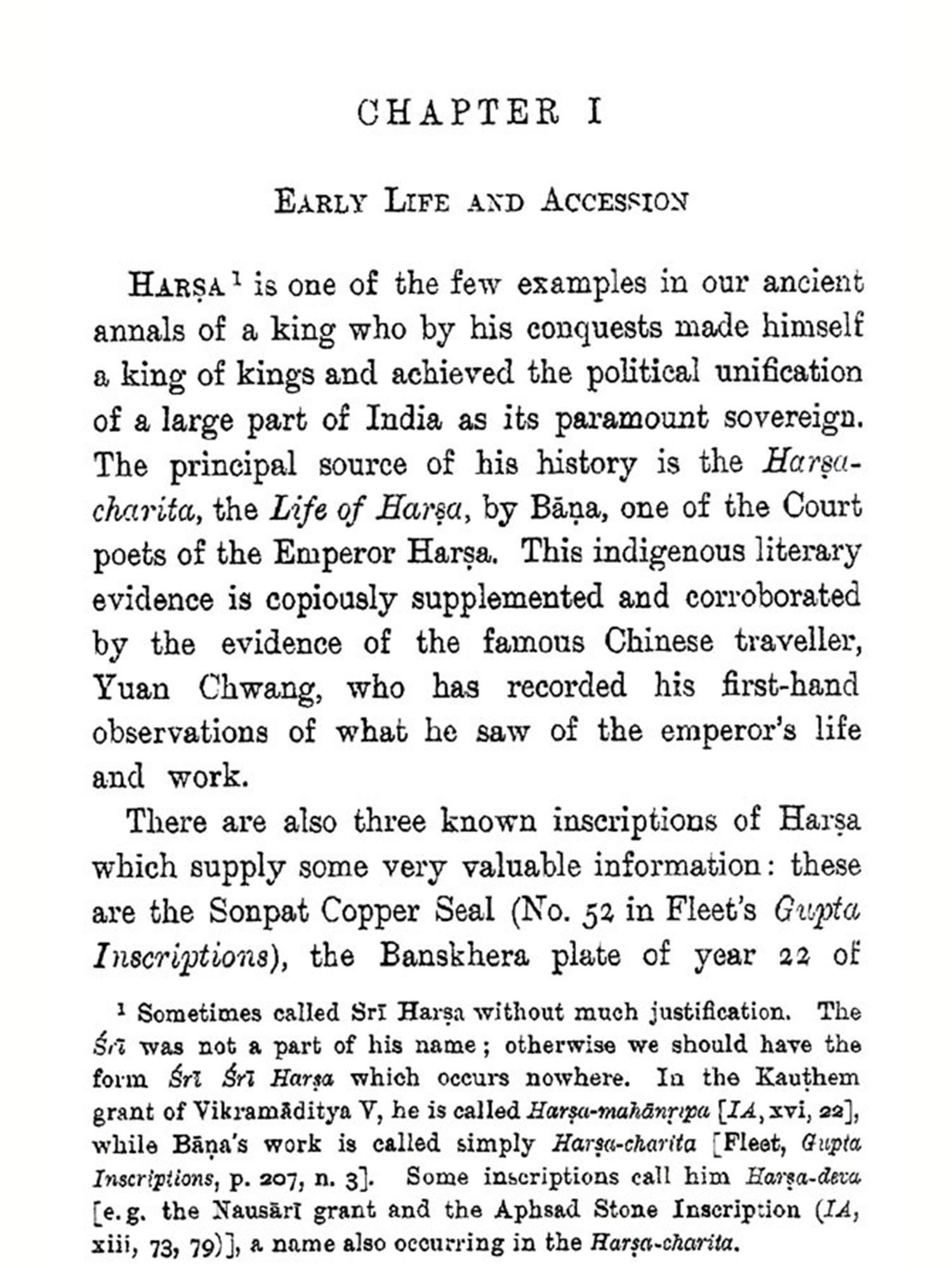
THERE are very few among the Rulers of India whose history is so rich in both contents and materials as the history of Harsa. When all sources are utilized,' as observed by the late Dr. Vincent A. Smith, 'our knowledge of the events of the reign of Harsa far surpasses in precision that which we possess respect-ing any other early Indian king, except Chandragupta Maurya, and Aśoka. Indeed, the historical material is so abundant that it would be easy to write a large volume devoted solely to his reign.'
His early life and career form the subject-matter of the Harsacharita of Baņa, a writer of great repute in the history of classical Sanskrit, who wrote on Harsa as his court poet from his personal and intimate knowledge of his life and rule, and has given to Sanskrit literature one of its very few biographical works. Thus in Bāņa Harşa found his Boswell; but, though the historical value of the work as a whole is somewhat vitiated by its occasional outbursts of hero-worship and flights of fancy, to which a poet laureate's panegyric on his royal patron naturally lends itself, the line between fact and fiction is easily discernible, and the kernel of truth separated from its envelope of embellishments and exaggerations.