| Specifications |
 |
Publisher: Sterling Publishers Pvt. Ltd. |
| Author S. Seshadri | |
| Language: English | |
| Pages: 178 | |
| Cover: PAPERBACK | |
 |
8.5x5.5 Inch |
 |
Weight 220 gm |
| Edition: 2014 | |
| ISBN: 9788120789869 | |
 |
HBP821 |
| Delivery and Return Policies |
 |
Usually ships in 3 days |
 |
Returns and Exchanges accepted within 7 days |
 |
Free Delivery |


1854
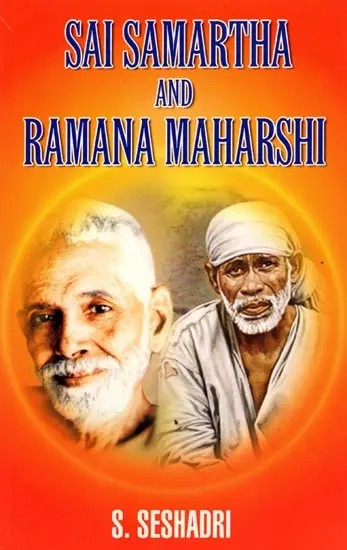
young lad, fakir, entered Ainto an obscure village in Ahmednagar District in
the then Bombay Presidency. The newcomer was around 16. years of age; nothing
was known about his name, parentage, antecedents, etc. For a few months he
stayed under the shade of trees and wandered in the nearby woods, caring little
for food or comforts. Attracted by the divine glow radiating from this lad, a
fortunate village lady, Baija Bai, chose to follow him and feed him. The lad
abruptly left the village and came back after a few years with the marriage
party of Chandbai Patel of Dhoopkeda. Thereafter, he never left Shirdi and its
neighbourhood. Mahlsapathy, the venerated priest of Khandoba Temple, called him
'Baba Sayee', and the name Sai Baba stuck to him. Till date it is not
authentically known if he was a Hindu Saint or a Muslim Aulia. Donned like a
Muslim he stayed in the old mosque in the village, but large number of Hindus
were attracted by his superhuman powers. Today, his name 'Sai Baba' is a
household word, the credit for which goes to the tremendous prachar done by Sri
Narasimha Swamiji for nearly two decades. In 1896, a young lad of seventeen
years, responding to an inner call, entered into Arunachala (Tiruvannamalai)
following a death experience he had and responding to the call of his Father.
Entering into the innermost shrine of the temple of Lord Arunachaleswara was
the supreme moment of his life, the point at which the old and false worldly
life may be said to be 'rung out and the new and true life in the Father and
the Self 'rung in'. He was always engaged in constant tapas totally devoid of
body-consciousness. The masses called him 'Brahmana Swami and later he was
revered as Ramana Maharshi and Bhagavan Ramana. As Sai Baba never left Shirdi
till his Mahasamadhi in 1918 Bhagavan Ramana also never left Tiruvannamalai
till his nirvana in 1950. Sri Narashimha Swamiji stayed for three years in the
ashram of Ramana Maharshi seeking God or self-realisation; Sai Samartha and
Ramana Maharshi there is a cave in the ashram named after Narashimha Swamiji,
where he did tapas under the guidance of Ramana Maharshi. Sri Swamiji wrote the
first biography of Ramana Maharshi appropriately titled as Self Realisation.
Because the essence of Ramana's teaching was that everyone should realise the
'Self by constantly enquiring who the 'T' is. Then why did Swamiji leave
Ramana? To understand the real nature of a 'rare' saint like Sai Baba, one
should have the divine grace and powerful receptivity. Bhagavan Ramana provided
these essentials and thus Swamiji was in a position to realise the divine
nature of Sai Baba when he visited his Samadhi Mandir. The approach and
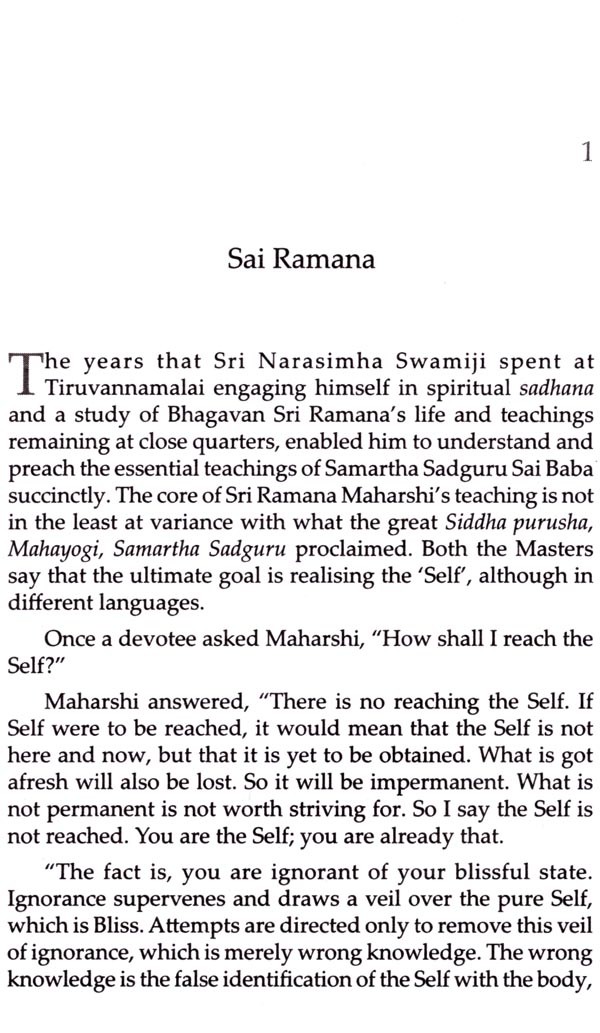
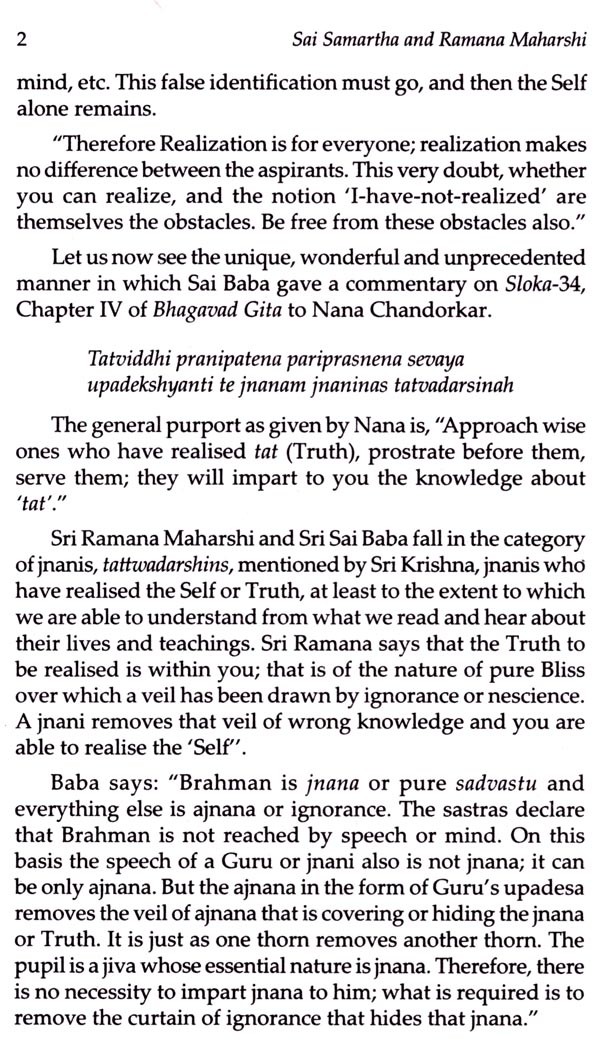
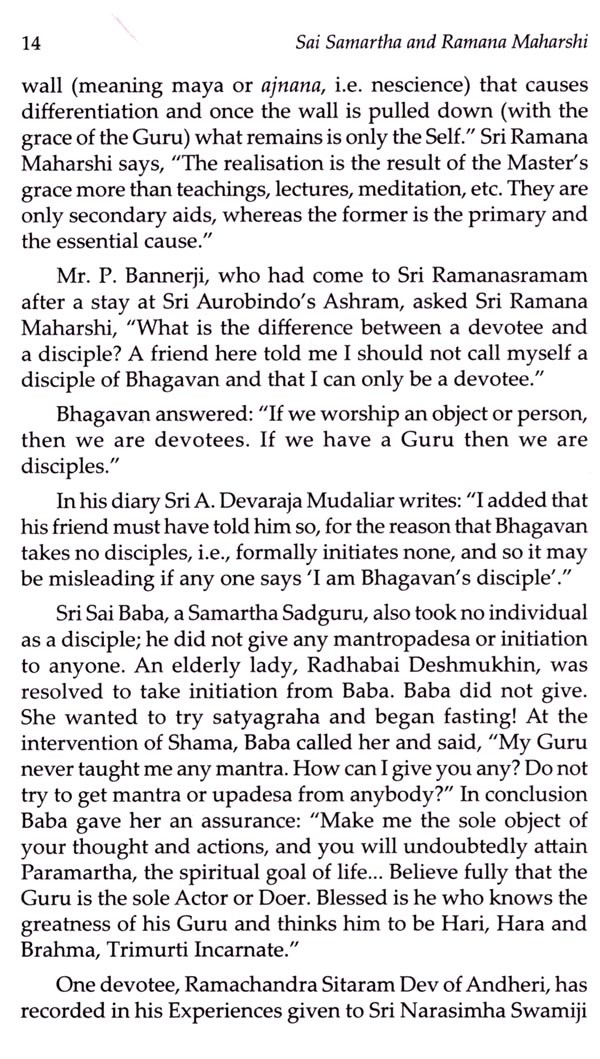
teachings of the two Masters may seem to differ for a casual observer. But when
one studies the two, no difference can be seen. Both of them stressed the need
to do atmavichara, to find out 'Who am I?' The manner in which each of them taught
depended upon the receptivity of the individual. Both of them extolled the
efficacy of absolute or unconditional surrender, as effective means to efface
the ego. Significant is the 'Love' that they radiated and showed to one and all
without any discrimination. They exhorted their devotees to love all. In 2002,
perhaps as ordained by both Sai Samartha and Ramana Maharshi. I was fortunate
to get acquainted with Sri V. Venkataraman, grandson of Ramana's uncle Subbier
from whose house at Madurai, Ramana started his journey to Arunachala in search
of his 'Father'. Sri Venkataraman felt the similarities in the teachings of Sai
and Ramana and persuaded me to write articles highlighting such similarities.
He shared valuable books with me on the life and teachings of Ramana. As I read
them, I found both the Masters distributed one and the same elixir, although in
different flavours and containers. In February 2005, by the grace of my Master
Sri Sai, I started writing editorials in Sai Sudha, official organ of All India
Sai Samaj, Chennai, highlighting the remarkable similarities between the two
masters. I hope these will be relished by the devotees of both Sri Sai and Sri
Ramana.
S.
Seshadri (b. 1930) was employed in an American Oil Company, Caltex, Chennai,
and keenly volunteered in Sri Ramakrishna Math and All India Sai Samaj (AISS),
Chennar. He established a library of over 6000 books on various subjects left
by Sri Narasimhaswamiji and joined as honorary librarian. He was also elected
as a member of the Managing Committee of AISS and served as Honorary Secretary
of AISS from 1964-70. He organised. All India Sai Devotees conventions every
year in various parts of Madras state. He has edited and written editorials in
Sai Sudha from 1997 to 2013. He republished the various books written by Sri
Narasimhaswamiji, translated most of these books in Tamil and had them
published by AISS. The first biography of Sri Sai Baba in Tamil in 1969, Kan
Kanda Daivan, and the Tamil biography of Sri Narasimhaswamiji were authored by
him. He translated the first biography of Sri Ramana Maharishi, Self
Realisation by Sri Narasimhaswamiji, into Tamil and published it in 2013.

Send as free online greeting card